How mahjong solitaire works
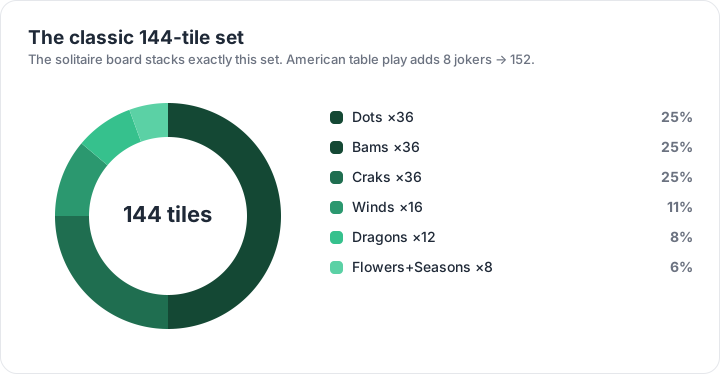
The board stacks the classic 144-tile set into a layered pyramid. Your goal is to remove every tile in pairs:
- A free tile has nothing sitting on top of it, and at least one of its left or right sides is open.
- Click two free tiles with the same face — or any flower with any flower, any season with any season — and both leave the board.
- Clear the board to win. Every suited and honor tile exists four times, so every pair you see has a twin somewhere in the stack.
The tools on this board
- Hint — outlines a removable pair, whenever one exists.
- Undo — restore your last removed pair. Regret is a strategy.
- Shuffle — rearranges the faces of the remaining tiles when no free pairs are left. It is the escape hatch from a dead board.
- Timer and counter — for the competitively inclined; the tiles do not care.
Everything runs in your browser: the board never uploads a move, has no account, and works offline once the page has loaded.
Three habits that clear boards
- Free the middle before the edges. Edge tiles mostly stay free on their own; the stack’s interior is where boards jam. Removing tall-center tiles early opens options for the whole endgame.
- Break symmetry on purpose. If the left and right halves of a layer can each remove a pair, remove the one whose exposed neighbors unlock more new free tiles — count the unlocks, not the pairs.
- Spend flowers and seasons early. The eight bonus tiles match each other in groups, so they are four free lunches — cash them while the board is open.
Is this the same as table mahjong?
Different game, same tiles. Mahjong solitaire was invented as a computer game in the 1980s: one player, matching pairs, no turns, no scoring. The four-player games — American card mahjong and the Chinese family — are the originals, and they play nothing like this. What solitaire does share is the tile set, which is exactly why it is the fastest way to learn the faces before a real table: ten minutes a day and the difference between a 6-crak and a 9-crak stops mattering. When you are ready for the table game, the complete walkthrough starts from zero.
A word on dead boards
Random boards can run out of free pairs before they run out of tiles — that is the game’s design, not a bug in yours. When the board announces it, hit Shuffle and keep going; purists who want no-assist runs can simply never press it. Winning without shuffles, hints or undos, under par time, is the classic four-star clear.