Stage 1 — Learn the 34 faces, not 152 tiles (30 minutes)
An American set has 152 tiles but only 34 distinct faces plus flowers, seasons and jokers. Every numbered tile exists four times, so recognizing a face is four times more valuable than it looks.
- Dots (circles) — count the circles. One dot through nine dots.
- Bams (bamboo) — count the sticks; the 1-bam is a bird.
- Craks (characters) — a Chinese numeral over the character 萬; the corner numeral tells you the rank.
- Winds — East, South, West, North, written as letters.
- Dragons — Red 中, Green 發, and the framed White (players call it “soap”).
- Flowers and seasons — eight bonus tiles that are matched as groups in play.
- Jokers — eight all-purpose tiles with their own rules.
Fastest way to lock in the faces: play ten minutes of mahjong solitaire. Matching pairs forces you to read every face, and the game tells you instantly when you misread one.
Stage 2 — The shape of a turn (15 minutes)
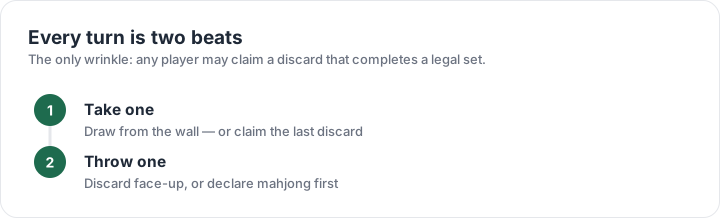
Every turn in mahjong is the same two-beat: take one tile, throw one tile. You take from the wall (draw) and throw into the middle (discard). The only wrinkle: if someone throws a tile you need, you can claim it out of turn and expose the set it completes. That is the entire engine of the game.
Stage 3 — Read your first card line (20 minutes)
The NMJL card lists the hands that can win. A line tells you four things: which suits to use (marked X, Y and Z for the three suits), how the tiles group (pairs, pungs, kongs, quints, or runs), whether the hand may be exposed, and the point value. Walk through one line-by-line example in how to read the 2026 card — after that single example the whole card opens up.
Stage 4 — The Charleston, rehearsed (10 minutes)
The pre-game pass confuses everyone exactly once. Rehearse the order three times alone, calling it out loud: left, across, right — three tiles each pass. Second Charleston only if everyone agrees, and it runs in reverse. The full detail, including blind passes and the courtesy pass, is on the rules page.
Stage 5 — Play with training wheels
Your first real games should have two accommodations, agreed in advance: the card stays open in front of you the whole time (it always should anyway), and one experienced player checks your exposures before you place them. Ask the table to call your illegal jokers gently — that single rule produces most beginner mistakes, and the joker rules page clears it up in two minutes.
What to buy (and what to skip) for game one
| Item | Needed for game one? | Note |
|---|---|---|
| American 152-tile set | Yes | Chinese 136/144-tile sets lack jokers — see the buying guide. |
| Four racks | Yes | Many sets include them; they hide your hand and hold exposes. |
| Current NMJL card | Yes | One per player, from the League itself. |
| Pusher arms | Nice to have | Build the wall faster; not required. |
| Scoring sticks / chips | Skip at first | Beginners settle points with the calculator and small change. |
| Automatic table | Skip | A luxury for later years, not for learning. |
The one-week practice plan
- Day 1–2: solitaire ten minutes a day; learn the 34 faces cold.
- Day 3: read the rules page end to end once — do not memorize, just map the territory.
- Day 4: read the card guide and mark three hands you could realistically build.
- Day 5: rehearse the Charleston out loud; explain the turn structure to someone.
- Day 6: play a full game with the checklist above.
- Day 7: first real game night. Bring the calculator for scoring.
When the first game is behind you, the fastest progress comes from strategy — beginners lose most points to defensive discards, not to hand selection.