The tiles
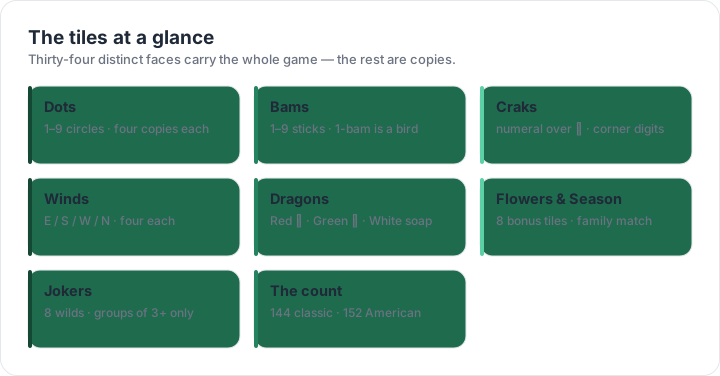
Thirty-four distinct faces carry the whole game. The count table is worth one careful read, because players argue about it constantly:
| Group | Faces | Copies each | Total |
|---|---|---|---|
| Suits (dots / bams / craks) | 9 × 3 | 4 | 108 |
| Winds | 4 | 4 | 16 |
| Dragons | 3 | 4 | 12 |
| Flowers & seasons | 8 | 1 | 8 |
| Classic total | — | — | 144 |
| Jokers (American only) | 1 | 8 | 152 |
- Dot (circle)
- One of the three suits; tiles show one to nine circles. Count them.
- Bam (bamboo)
- The stick-suit, one to nine. The 1-bam is traditionally a bird.
- Crak (character)
- The character suit: a Chinese numeral over 萬. Corner numerals give the rank.
- Winds
- East, South, West, North — four copies each, printed as letters.
- Dragons
- Red (中), Green (發) and White. Four copies each, twelve per set.
- Soap
- Table slang for the White dragon — the blank framed tile.
- Flowers and seasons
- The eight decorative bonus tiles (梅蘭菊竹 and 春夏秋冬 families). In American play they are ordinary tiles that match each other as groups.
- Joker
- Eight all-purpose tiles that substitute inside groups of three or more — never in pairs or singles.
Groups
- Pair
- Two identical tiles. No jokers allowed, ever.
- Pung
- Three identical tiles, exposed or concealed.
- Kong
- Four identical tiles.
- Quint
- Five identical tiles — requires at least one joker to exist.
- Sextet
- Six identical tiles.
- Consecutive run
- A printed sequence of tiles collected exactly as the card lists them.
- Exposed / concealed
- Groups claimed from discards are exposed face-up; concealed hands keep everything hidden until the win.
The Charleston and the table
- Charleston
- The required pre-game exchange: pass three tiles left, three across, three right. A second, reversed Charleston runs if all agree.
- Blind pass
- On each Charleston’s final pass, forwarding one to three just-received tiles without looking at them.
- Courtesy pass
- The optional exchange of up to three tiles with the player across; both players must agree on the number.
- Wall
- The two-high rows of tiles built in front of each player; draw tiles come from the wall.
- Break
- The spot where East opens the wall for the deal, chosen by dice count.
- Live wall
- The tiles still available to draw. When it empties, the hand is a draw.
Play and penalties
- Draw
- Taking one tile from the wall on your turn.
- Discard
- The tile thrown face-up to end your turn.
- Call
- Claiming a discard for a group or for mahjong, out loud and immediately.
- Mahjong
- The winning declaration: your fourteen tiles match a current-card line legally.
- Dead hand / dead tile
- A hand that can no longer win (illegal joker, wrong exposure); a discarded tile is dead once play moves on and cannot be claimed.
- Joker exchange
- Swapping a natural tile for a joker in another player’s exposed group on your turn.
- Doubles
- Bonus multipliers printed on card lines — commonly jokerless and singles-and-pairs conditions.
Etiquette in five lines
- The card stays visible and the tiles stay behind your rack — no tile peeks.
- Claims happen immediately; a beat of silence kills the call.
- Wins are verified together, points are read off the card, and payments settle before the shuffle for the next hand.
- Corrections are gentle and immediate — every veteran at the table once put a joker in a pair.
- Beginners get the benefit of every doubt on their first game night; that is the custom, and it is how the game grows.
Want the rules these terms live inside? Start with the complete rulebook or the whole walkthrough.