The tile set
American mahjong uses 152 tiles: 36 dots, 36 bams and 36 craks (four of each of the nine ranks in three suits), 16 winds (four East, South, West, North), 12 dragons (four each of Red, Green and White), 4 flowers, 4 seasons and 8 jokers. The full anatomy, with pictures of every group, is in anatomy of a set.
Setup, seats and the deal
- Four players. Everyone rolls both dice; the highest roll takes East and deals first. After each hand the deal passes to the player on East’s right.
- Each player builds a wall of 19 stacks, two tiles high (38 tiles) behind their rack.
- East breaks the wall with two dice and takes the first 14 tiles; every other player takes 13.
- If East’s 14 tiles already match a hand on the card, East may declare mahjong immediately — rare, but it has happened at every long-standing table.
The Charleston — the required exchange
Before play begins, tiles move around the table in a fixed choreography. It exists so every hand starts with choice instead of accident.
- First pass — to the left. Pass three tiles you do not want.
- Second pass — across. Pass three tiles to the player opposite.
- Third pass — to the right. On this final pass you may make a blind pass: push one, two or all three of the tiles you just received onward without looking at them.
- Second Charleston (optional). Only if all four players agree, the same three passes run in reverse: right, across, left. A blind pass is again allowed on the last pass.
- Courtesy pass. Finally, the two players across from each other may agree to exchange any number of tiles from zero to three. Either player may decline entirely.
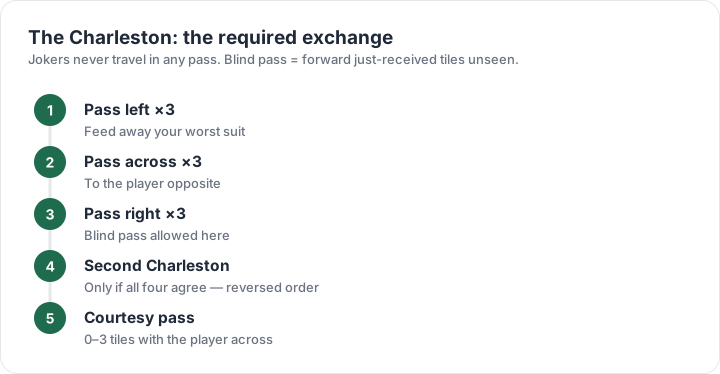
Jokers never travel. A joker may not be passed in any Charleston pass, blind pass or courtesy pass. Pass it and you have made an error — see the error table below.
The turn
Play proceeds counterclockwise (to the right around the table). Each turn is:
- Draw one tile from the wall (or claim the last discard — see calling).
- Discard one tile face-up, or declare mahjong if your tiles now match a card hand.
There are no sequences (chows) in American mahjong — only pairs and equal groups. That single fact is why the card’s hands are built from pairs, pungs, kongs, quints and sextets, and why almost any discard can be dangerous.
Calling discards
- You may claim the most recent discard if it completes a pung (3), kong (4), quint (5) or sextet (6) that your chosen hand allows, or if it completes your entire hand.
- Claiming for a group: expose that group face-up on your rack, then discard to end your turn. Exposed groups stay exposed for the rest of the hand.
- A call of mahjong outranks a group call: if two players want the same tile, the mahjong caller takes it.
- A tile someone has already claimed for a group may not be taken for a later group — first clean call wins, and the discarded tile is dead once the next player has drawn.
Jokers
- A joker may substitute for any tile inside an exposed or concealed group of 3+ — pungs, kongs, quints, sextets.
- A joker may never stand in a pair or as a single tile. A hand with a joker sitting in a pair is illegal — the classic beginner dead hand.
- You may exchange a joker from another player’s exposed group with the natural tile from your hand, on your turn. The freed joker joins your rack.
- Jokers cannot be discarded? They can — discarding a joker is legal and it can then be claimed like any tile by a player who needs it for a legal group.
Errors and dead hands
| Situation | Standard ruling |
|---|---|
| Wrong tile exposure called by accident | Correct it before your discard; after the discard the exposure stands if it can still be part of a legal hand. |
| Hand declared but does not match the card | Dead hand — you stop playing and pay the winner as if someone else had won, if the hand reaches a conclusion. |
| Joker in a pair discovered mid-hand | The hand is dead once discovered. Check exposures before you pass your discard. |
| Discarding out of turn | The discard returns if noticed immediately; otherwise play continues and the tile stands as discarded. |
| Short wall / wrong count found during play | Fix the wall if unnoticed play was minimal; otherwise the hand is replayed without score. |
Ending a hand
A hand ends when someone declares mahjong (verified against the card) or when the wall runs out of draw-able tiles, which is a draw — no score. The winner collects the hand’s value in points from the other players: a self-drawn win is paid at double by all three; a win off a discard is paid at full value by two players and double by the discarder. Work any hand through the scoring calculator to see the split.