Hand points
Discarder pays
Each other player pays
Winner collects total
Copied ✓
How American mahjong scoring works
America scores hands, not tiles. The card prints a point value next to every hand — the smallest hands start at 25 points — and that value is the whole basis of payment. Three things then move the number:
- Doubles printed on the card. Lines can carry conditions worth double: played jokerless, or a singles-and-pairs construction. When a hand earns two doubles the value multiplies by four. The card marks exactly which conditions apply where — if nothing is marked, no doubling happens.
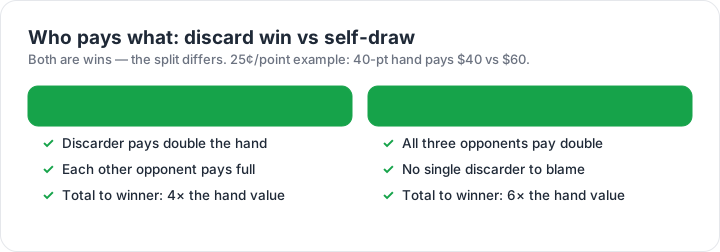
- How the win arrived. Winning on a tile you drew yourself is the strongest form: all three opponents pay double. Winning on a discard is paid at the hand’s value by two players — and the discarder pays double for the mistake.
- The table stake. Points convert to money at whatever the table agrees — a quarter a point is the classic beginner stake; dollar-a-point tables exist and hurt. The stake selector above matches either.
Worked examples
| Hand (card value) | Conditions | Points | Winner collects (25¢/pt) |
|---|---|---|---|
| 40 | Off a discard | 40 | $40.00 |
| 40 | Self-drawn | 40 | $60.00 |
| 40 | Discard + jokerless ×2 | 80 | $80.00 |
| 30 | Self-draw + singles & pairs ×2 | 60 | $90.00 |
| 25 | Off a discard, both doubles ×4 | 100 | $100.00 |
Every row above is the calculator’s arithmetic on the payment rules: full value from two players plus the discarder’s double equals four hand-values total on a discard win; three doubled payments equal six hand-values on a self-draw.
Keeping the table honest (and friendly)
- Read the value straight off the card with the hand laid down — no memory, no disputes.
- Verify doubles together, the same way wins are verified together. A double claimed in error is corrected the same as any misread.
- Settle each hand immediately. The calculator’s copy button puts the split in your notes so end-of-night totals take a minute.
- House variations exist — some tables cap the discarder’s double or play “pay the winner only.” Agree the convention before game one; the rules here are the standard baseline.