What kind of mahjong is this?
There is more than one mahjong. The version most often played in American living rooms, senior centers and online groups is American mahjong — four players, racks, eight jokers, a required tile-exchange called the Charleston, and a yearly card of winning hands published by the National Mah Jongg League (NMJL). If your group plays with a printed card, this is the guide for you. If you want the Chinese family of rules instead, see Chinese mahjong rules.
What you need before the first deal
| Equipment | What it does | Notes |
|---|---|---|
| 152-tile American set | Three suits, winds, dragons, flowers, seasons, 8 jokers | Chinese sets lack jokers — check the count. |
| Four racks | Hide your hand; hold exposed sets | Pushers make wall-building fast. |
| Two dice | Pick the first dealer and the wall break | Nothing else — no dice math in play. |
| Current NMJL card | The menu of legal winning hands | One per player, always face-up. |
The ten steps of a hand
- Seat and dealer. Everyone rolls both dice; highest total takes the East seat and deals first. The deal rotates counterclockwise after each hand.
- Build the walls. Each player stacks 19 tiles two-high (38 tiles) in front of their rack. Four walls of 38 make the full set of 152.
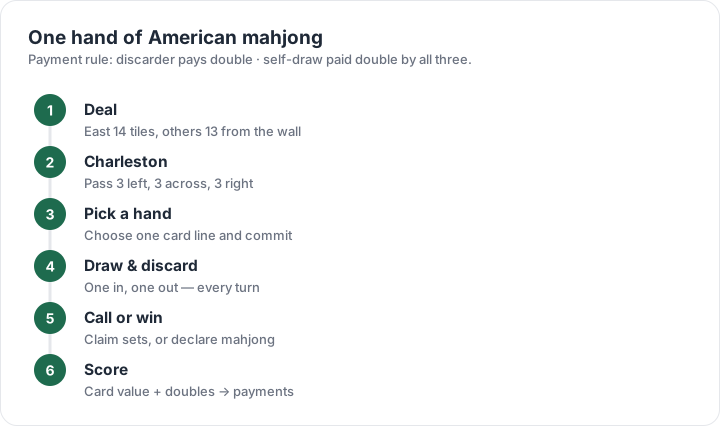
- Take your hand. Counting tiles from the break in the wall, East takes 14 tiles and every other player takes 13.
- The Charleston. Before any play, pass three tiles to the player on your left, then three across the table, then three to your right. A second Charleston (right, across, left) runs only if all four agree. Details and etiquette are in the Charleston rules.
- Pick a target hand. Scan the card and choose a hand that matches what the Charleston left you — suit, pattern and how exposed it can be.
- Draw, then discard. East discards one tile to start. From then on, on your turn you draw one tile, then discard one tile face-up into the middle.
- Call discards you need. If a discarded tile completes a pung, kong, quint or sextet for your hand, claim it out loud and expose that set on your rack. You may also claim a tile that completes your whole hand — that call wins immediately.
- Use jokers ruthlessly. A joker stands in for any single tile inside an exposed group — pungs, kongs, quints, sextets — but never for a tile in a pair or a single. Jokers can even be traded out of other players’ exposed sets.
- Call mahjong. When your 14 tiles match a hand on the card — with legal exposures and no illegal jokers — declare it, lay the hand down, and check it against the card together.
- Score the hand. Read the point value printed next to the hand, apply any doubles, and settle payments: a player who discards the winning tile pays double, and a self-drawn win is paid by all three opponents at double. Our scoring calculator does the arithmetic.
Your first three turns, translated
New players freeze at the first discard because they are reading every hand on the card at once. Do this instead: after the Charleston, choose exactly one hand and ignore the rest. Ask three questions every turn — did I draw closer to my hand? is someone’s exposed set blocking it? what am I throwing away, and could it complete someone? The game slows down remarkably once those three questions are habit.
Mistakes every first-timer makes
- Passing tiles in the Charleston that fit two hands — pass from your weakest suit first.
- Exposing a set too early. Every exposed tile tells the table what you are collecting; with a concealed hand available on the card, staying quiet is often worth more points.
- Putting a joker in a pair. It is the single most common illegal hand — jokers never substitute inside a pair or a single tile slot.
- Playing the card from last year. Hands change annually; an old-card hand is a dead hand. See what changed on the 2026 card.
When you can finish a hand without re-reading the rules, move on to strategy — defense, hand switching and joker management are what actually win tables. And if the tiles themselves still feel foreign, a few rounds of mahjong solitaire teach the faces faster than any diagram.