The set: 136 tiles, no jokers
A Chinese set carries 136 tiles — the same three suits of dots, bams and craks (36 each) plus winds and dragons (16 + 12). The American extras — eight jokers, the fourth flower group, Arabic numerals on every tile — are absent. Flowers exist in many sets and are set aside when drawn, replaced from the wall, but they are decoration, not jokers.
Hands of thirteen, wins of fourteen
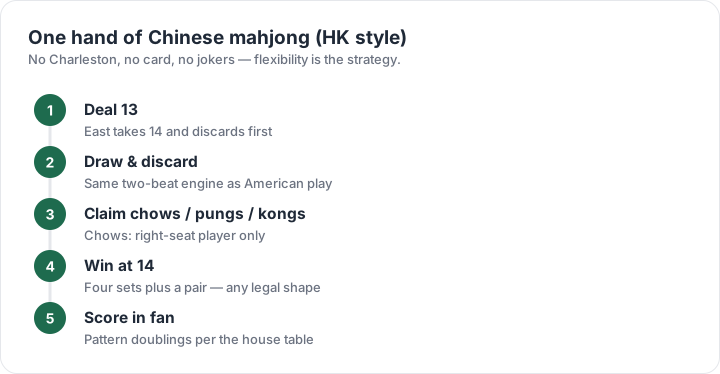
Each player holds 13 tiles and wins by completing a legal fourteen-tile shape: four sets and one pair. A set is either a chow — three consecutive tiles of one suit, like 4-5-6 of dots — or a pung/kong of identical tiles. The winning draw or claimed tile is the fourteenth.
That example shows the whole idea: a dot chow, a bam chow, a crak pung, an East wind pair and a dragon pung — four sets plus the pair. Chows are the big difference from American play, where identical groups only.
The turn: same engine, more freedom
- Draw from the wall, discard one tile — identical to American play.
- Claim a discard for a pung, kong, or the chow it completes — but only the player to the discarder’s right may claim for a chow.
- No Charleston and no card: you may build any legal pattern the table’s scoring rewards.
- A draw is declared when the wall is exhausted; many tables play a “dirty” last turn where nobody may claim a chow that would extend the game.
Scoring by patterns (fan)
Chinese hands are priced in fan — doubling units for patterns like pungs only, one-suit hands, all chows, dragon sets, seat winds, or the fully concealed “four silent sets.” There is no annual authority: Hong Kong tables commonly play 3-fan minimums, other regions count differently, and apps enforce whatever house style their authors chose. The practical rule: agree the fan table before game one and write it down.
| Chinese (HK style) | American | |
|---|---|---|
| Tiles dealt | 13 (win at 14) | 13/14 (win at 14) |
| Legal wins | Any four sets + pair | Only current-card lines |
| Chows | Yes (right-seat claim only) | Never |
| Jokers | None | 8 per set |
| Pre-game pass | None | Charleston |
| Scoring authority | House fan table | Annual NMJL card |
| Minimum win | Table-set (e.g. 3 fan) | 25 points |
Which should you learn?
Learn the one your table plays — and both eventually, because they exercise different muscles. Chinese mahjong rewards flexibility: hands are improvised around chows and scoring patterns every deal. American mahjong rewards card reading and defense. The turn engine you practiced in the walkthrough transfers completely; only the target shapes change.
Where the apps and films sit
The mahjong you meet in international films and most mobile apps is the Chinese family (or its four-player simplifications), while the tile-matching computer game is neither — it is mahjong solitaire, a twentieth-century single-player invention that borrowed the tiles. Knowing which one someone means is half the vocabulary battle.