The card is the constitution
In Chinese-family mahjong, any legal pattern can win. In American mahjong, only the hands printed on the current NMJL card can win — roughly fifty lines, reprinted with new hands every year. Everything else in the rules exists to serve that card: the Charleston filters your tiles toward a line, exposures announce your progress, and the value column prices each hand. Reading the card is a skill of its own, covered step by step in the 2026 card guide.
Quints, sextets and other American oddities
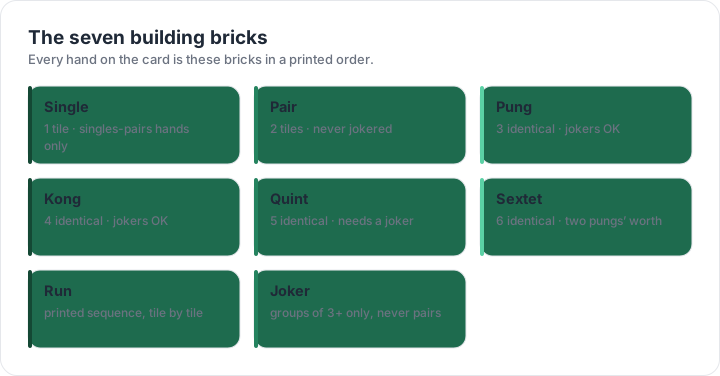
Chinese mahjong groups tiles in threes and fours. American card hands also use:
- Quints — five identical tiles. Impossible without a joker, which is why quint hands are where jokers shine.
- Sextets — six identical tiles. Two pungs’ worth of one face.
- Singles-and-pairs hands — hands built from lone tiles and pairs, which are special: no joker can help anywhere in them, and completing one usually scores a double.
- Consecutive runs — fixed sequences like 1-2-3 across suits, printed explicitly on the card line by line.
The joker rulebook
Eight jokers per set, and four rules govern all of them:
- Jokers substitute inside groups of 3+. A pung may be two natural Red dragons and one joker; a kong may be two naturals and two jokers; a quint can even be one natural and four jokers.
- Jokers never sit in pairs or singles. If a card hand contains a pair, that pair is two natural tiles, always.
- Jokers can be exchanged out of exposed groups. Holding the natural tile that someone’s joker is standing in for? On your turn, swap them: their joker comes to your rack, your natural joins their set. This is legal, encouraged, and occasionally brutal.
- Jokers do not travel in the Charleston and may not be passed blind or in the courtesy pass.
Exposure: your hand is your announcement
Claiming a discard forces you to expose the completed group face-up. Exposures never go back into hiding, so every call narrows what the table knows about your card line. Card hands marked as concealable may be won without any exposure, and many of them carry a double for staying hidden to the end — the value printed on the card is paid at twice when the marked condition holds. Jokerless and singles-and-pairs hands commonly carry doubles too; your card marks exactly which conditions apply to each line.
American vs Chinese mahjong, side by side
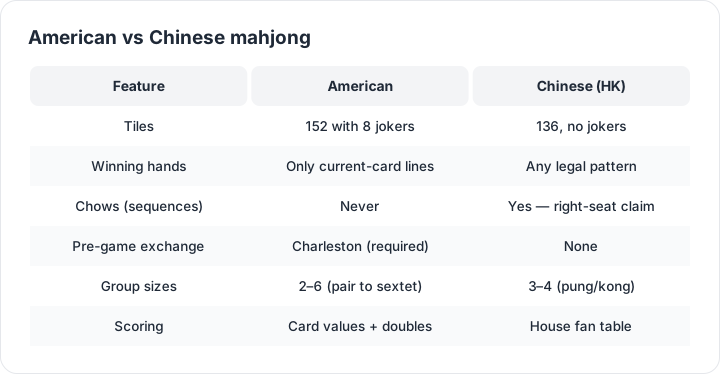
The deep-dive tour of the other family — tiles, chows and fan scoring — is in Chinese mahjong rules.
Forfeits and foul hands
- Dead hand: any hand that cannot legally win — wrong exposure, illegal joker placement, an old-card line. The player stops playing; at a completed hand they pay the winner’s value as if they had discarded the winning tile.
- Wrong mahjong declared: the hand is laid down, checked, found illegal and declared dead on the spot.
- Passing a joker in the Charleston: if caught before play begins, the pass is corrected; after play begins, most tables treat it as a dead hand. Agree the ruling before game one, not during it.
Tournament play in one paragraph
American mahjong has an organized tournament circuit operating under standardized tournament rules first codified in 2005 — timed hands, strict dead-hand enforcement and official scorers. Nothing at that level changes the rules above; it just enforces them without mercy. Beginners should play friendly tables until the dead-hand rules are reflexes.