What the card is (and is not)
The National Mah Jongg League has published an annual card of winning hands since the 1930s. The 2026 card is current from April 2026 through March 2027; when the new card arrives each spring, every hand on the old card retires — playing an old-card hand is playing a dead hand. The card is a rules reference, not a strategy guide: it lists hands and values, and it is always face-up at the table. Nothing about it is memorized.
Buying: cards are sold directly by the League (standard and large-print sizes — same hands, bigger type) and by many game retailers. For the official price and shipping, order from the League itself; a card is valid for the whole League year.
Anatomy of a card line
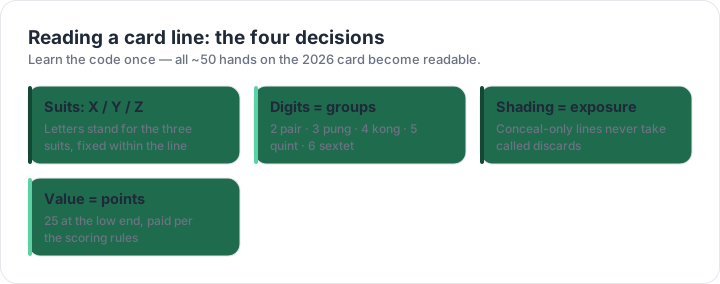
Every line on the card encodes four decisions. Learn the code once and all roughly fifty hands are readable:
- Suits — the letters X, Y and Z. Each letter stands for one of the three suits, consistent across the whole line. A line marked X.XX.Y means one tile of suit X, three more of suit X, then a group of suit Y. Which physical suit each letter is stays fixed within a line’s section.
- Grouping — the numbers. Digits tell you the group shapes: 2 = a pair, 3 = a pung, 4 = a kong, 5 = a quint, 6 = a sextet. “0” and “D” mark dragons, and a sequence like 1 2 3 4 5 6 7 prints exactly the run to collect.
- Exposure — the shading. Marked sections show whether a hand may be exposed, must be concealed, or carries a double for staying concealed. If the card allows exposure, calling discards for it is legal; if it must stay hidden, every tile comes from your own draw.
- Value — the right column. The points the hand scores, from 25 at the low end to 125 and beyond for the monsters. A raised value usually means a harder collect or a concealment requirement.
How the 2026 card is organized
Recent-year cards group hands into sections by construction. The section vocabulary is stable across years — learn it once and every future card reads itself:
| Section family | Hands built around | Beginner-friendliness |
|---|---|---|
| The Year | This year’s digits as pungs/kongs | Medium — memorize once |
| Winds & Dragons | Honor-tile groups | Easiest — start here |
| Consecutive Runs | Printed 1–9 sequences across suits | Medium |
| Pungs & Kongs | Plain identical groups | Easiest |
| Quints / Sextets | 5–6 of a face (joker showcase) | Tricky — joker-dependent |
| Singletons & Pairs | Ones and twos only, no jokers | Hardest — but doubles |
Sections shuffle composition every year, so the 2026 lines are new hands, but the section vocabulary above transfers from every earlier card.
Choosing your line at the table
- Two suit families maximum. After the Charleston, count which suits you are deep in and shortlist lines that use them.
- Check the exposure rule before you fall in love. A beautiful concealed-only line is useless if two of your tiles are already exposed on your rack.
- Price the pivot. Lines that share their pairs or pungs with a neighbor line let you switch hands mid-game when the wall turns hostile — strategy in one sentence.
- Watch the doubles. Concealed, jokerless and singles-and-pairs conditions can double a line’s value; the calculator shows what a double does to the payment split in real money.
Practicing the card alone
Deal yourself fourteen tiles from a set, scan the card for a line your tiles could become with three more draws, then state the line’s value and exposure rule out loud. Three deals a day for a week makes line-reading automatic. Pair it with solitaire for tile-face fluency and you will be the fastest reader at your first game night.
A note on reproductions
The card is copyrighted — the League funds its year on card sales. Photocopies and home-printed replicas spoil the tradition for everyone; the genuine article is inexpensive, large-print, and lasts the year. This page explains how to read any card without reproducing one.