The Charleston is your first strategic act
Most players treat the Charleston as bookkeeping. It is the cheapest hand-improvement in the game:
- Pass from your weak suit first. Whatever you are shallowest in after the deal is what you feed away — three tiles of your worst suit is a gift that keeps giving.
- Break pairs you will not use. A pair of a suit you are abandoning is two decent passes; a single of that suit is one.
- Remember what you passed and where it went. The player on your left received three tiles you judged useless to you — that is the start of reading their hand.
- Blind pass on the last pass when your right-side neighbor is heating up. Pushing their feed onward unseen beats feeding a threatened line.
Choose hands by what the table tells you
- Count exposed groups before committing. Two exposed kongs in dots kill every dot-heavy line for the whole table — including yours.
- Prefer lines with a pivot twin. Adjacent card lines that share structure but swap one suit are worth their weight: when the wall starves your suit, you switch for the cost of a pair, not a rebuild.
- Concealed lines change your discard math. A concealment double means your own draws carry bonus value — call discards only for mahjong itself, not for sets.
- Short-wall awareness. Past the two-thirds mark, stop upgrading and start finishing: take the pung that leaves you one-out over the prettier concealed plan.
Defense: the skill that pays the bills
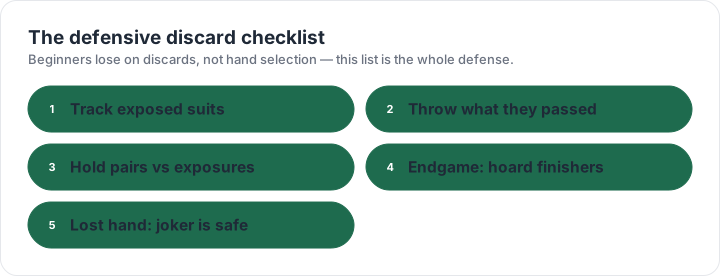
Every discard can cost you the discarder’s double. Defensive discarding is reading exposures and counting:
- Track each player’s exposed suit. Discarding into an exposed suit is how doubles happen; when a player is one group away, suit-adjacent tiles are live wires.
- Throw what they passed away. In the Charleston everyone fed away their worst suit — early-game discards from a player’s passed-away suit are usually safer than honor tiles.
- Pair-breaking discipline. Breaking your second pair of a suit an opponent is collecting is a donation. Hold pairs longer against hungry exposures.
- The wall-end squeeze. With fifteen or fewer tiles left, a hand that cannot win shifts to tile-hoarding mode: hold what completes likely card lines and discard only what exposes say is spent.
Jokers are ammunition, not decoration
- Spend jokers where doubles live. A jokerless double line is often worth more with zero jokers and the double than a bigger line padded with them.
- Exchange on your schedule. Taking an opponent’s joker strips their set and gains yours — but do it on a turn where the discard you must make afterwards is safe.
- Never let a joker babysit a pair. The classic illegal hand is a joker parked in a pair “temporarily.” It is dead the moment anyone checks.
The calling decision
Calling a discard exposes a group — a permanent information leak. The honest test: does this call win me the race or just announce me?
| Situation | Call or stay quiet | Why |
|---|---|---|
| The claim completes a kong or bigger | Call | Too big a chunk of the line to leave in the wall’s hands. |
| Wall past two-thirds and you are behind | Call | Race pressure beats information cost. |
| Early hand, concealed double line available | Quiet | The double pays for patience. |
| The claim adds a suit the table already fears | Quiet | You would be announcing your line while defending its suit. |
| Any claim for mahjong itself | Call — always | It ends the hand. |
Post-hand habits of winning tables
Score with the calculator so payment rules never smolder, and revisit one decision per hand — the pass, the call or the discard that felt closest. Ten hands a week with one honest review each beats a hundred hands on autopilot; and when you want to drill tile fluency without a table, solitaire is the sparing partner.